

Dear All ,
We spend years learning mathematics, science, engineering, medicine, literature, and languages. These subjects help us build a career.
But there is one life skill that determines whether we enjoy financial peace or live with constant money stress financial literacy.
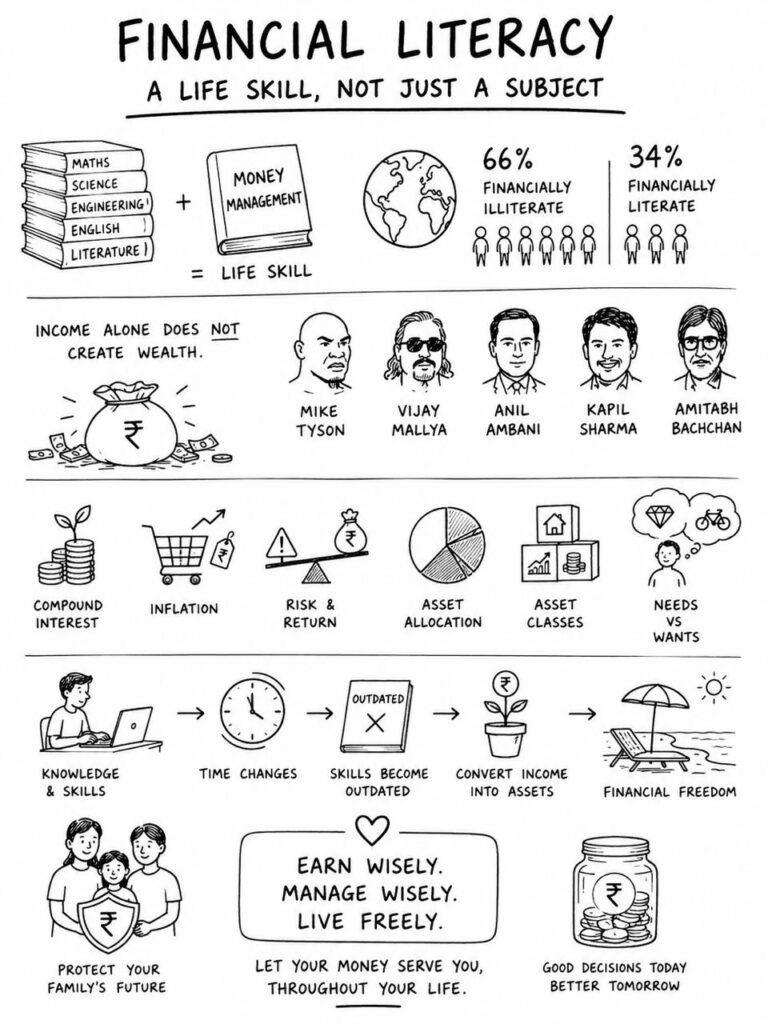
A recent global estimate suggests that only about 34% of people are financially literate, while nearly 66% lack basic financial knowledge.
Think about that for a moment. Two out of every three people are earning money without fully understanding how to manage it.
This is not just a statistic—it is a reality we see around us every day.
Many assume that earning more automatically leads to wealth. History proves otherwise.
We have seen celebrated personalities like Mike Tyson, Vijay Mallya, Anil Ambani, and Amitabh Bachchan face severe financial difficulties at different stages of their lives.
Their stories remind us that income alone does not create wealth; financial wisdom does.
Money management is not reserved for accountants or finance professionals. It is a life skill that every earning member of a family should possess.
Every individual should understand some basic financial concepts:
* The power of compound interest
* The silent impact of inflation
* The relationship between risk and return
* The importance of asset allocation
* Different asset classes and their role in wealth creation
* The difference between needs and wants
These are not investment topics they are life topics.
Remember, your income comes from your knowledge and your skills. But knowledge evolves. Technology changes. Industries transform. Skills that are valuable today may become outdated tomorrow.
If your income depends only on your profession, your financial future remains uncertain.
That is why it is essential to gradually convert your earned income into assets that continue working for you, even when you are not working. This is the true purpose of investing not chasing returns, but creating financial independence.
Financial literacy teaches us to make thoughtful decisions instead of emotional ones. It helps us spend wisely, save consistently, invest intelligently, and protect our family’s future.
At the end of the day, wealth is not about how much you earn. It is about how wisely you manage what you earn.
Because the ultimate goal is simple: Let your money serve you throughout your life, instead of spending your entire life serving money.
Kavita S Devi CFP cm
 We Listen: Discovery Stage
 We Plan: Enriching Lives
 We Built: Wealth Creation